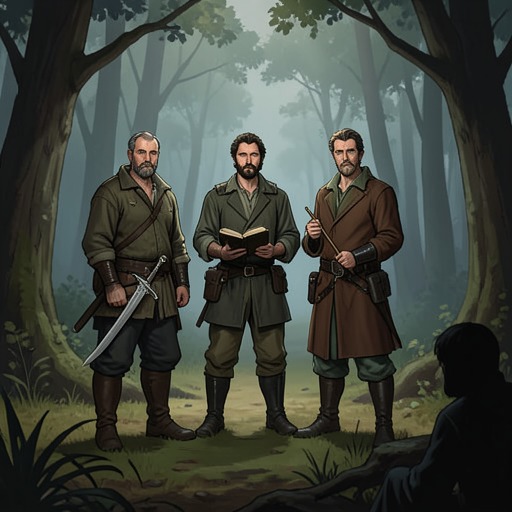
The Three Brothers’ encounter with Death
The Tales of Beedle the BardThe Three Brothers’ encounter with Death is the turning point in an embedded tale about the limits of human power over mortality. When three learned brothers evade a dangerous river by making a bridge, Death offers each a prize; their different choices then lead to sharply different ends. The eldest and second brothers attempt to master death through power and the recovery of the dead, while the youngest chooses only to delay their next meeting. Their fates make the story’s moral concrete: Death cannot finally be overcome, but can be met with wisdom rather than defiance.
The river crossing and Death’s offer
At twilight, the three brothers travel along a lonely, winding road and reach a river too deep to wade and too dangerous to swim. Rather than risk the water, they use their magical skill to make a bridge appear. Halfway across, they encounter a hooded figure: Death, angered because the travellers have escaped a river in which people usually drown.
Death conceals that anger beneath congratulations. He praises the brothers for their magic and claims that each has earned a prize for being clever enough to evade him. The offer turns their escape into a test of judgment: all three receive a gift, but the gifts reflect what each brother values and shape what follows.
Three gifts, three responses
The eldest brother is combative and asks for a wand more powerful than any other, one that will always win duels and suit a wizard who has conquered Death. Death takes a branch from an elder tree on the riverbank, fashions a wand from it, and hands it over. The second brother, arrogant and intent on humiliating Death further, asks for the power to recall the dead. Death picks up a stone from the riverbank and gives it to him, saying it can bring back the dead.
The youngest brother is described as both the humblest and wisest. He does not trust Death and asks instead for something that will let him leave without being followed. Reluctantly, Death gives him his own Cloak of Invisibility. The contrast is fundamental: the elder brothers ask for power that challenges death, while the youngest seeks a means of avoiding pursuit without claiming to defeat Death itself.
Death then stands aside, and the brothers continue on their way, discussing their extraordinary encounter and admiring their gifts. In due course they separate, each heading for his own destination. That parting begins three distinct outcomes, turning the apparent reward into a measure of how each brother understands the encounter.
The eldest and second brothers
After travelling for a week or more, the eldest reaches a distant village and seeks out a fellow wizard with whom he has a quarrel. Armed with the wand, he cannot lose the duel, and his opponent is left dead. He then goes to an inn and boasts loudly about the powerful wand he has taken from Death and the invincibility it gives him. The victory seems to confirm the wand’s promise, but his boast makes its possession known.
That night another wizard steals the wand while its owner lies asleep after drinking wine, and kills him. The eldest brother’s gift has helped him win a duel, but neither that power nor his claim to have conquered Death protects him from another person’s attack. Death takes him in the end, and the wand passes out of his possession through theft.
The second brother returns to the home where he lives alone and takes out the stone that can recall the dead. He turns it thrice in his hand; to his amazement and delight, the figure of the girl he once hoped to marry appears before him. Her return, however, is not a restoration to ordinary life. She is silent and cold, separated from him as though by a veil, and, although she has come back to the mortal world, she does not truly belong there and suffers.
Unable to bear the distance between them, the second brother is driven mad with hopeless longing and kills himself in order to join her. The stone fulfils its limited promise by summoning the figure of the dead woman, but it does not remove the boundary between life and death or give her a life she can inhabit. Death takes the second brother too: his attempt to reverse loss ends not in reunion as he hoped, but in his own death.
The youngest brother and the tale’s moral
Death searches for the youngest brother for many years but cannot find him. The youngest lives to a great age before taking off the Cloak of Invisibility and giving it to his son. Unlike his brothers, he does not use his gift to claim power over Death or to summon someone back from the dead. When Death finally comes, he greets him as an old friend and goes with him gladly; as equals, they depart this life.
The story’s moral, as explained by Albus Dumbledore, is that human efforts to evade or overcome death are doomed to disappointment. The youngest brother understands that, having escaped once, the best he can hope for is to postpone their next meeting. The eldest’s violence and the second’s attempt to reach the dead through necromancy both pit them against a cunning enemy who cannot lose. The youngest’s wisdom is not immortality, but acceptance of the limit that the other two try to deny.
The gifts, the legend, and its irony
The tale’s meaning is complicated by a legend that reverses its warning. According to that later belief, Death’s three gifts exist as real objects: an unbeatable wand, a stone that can bring back the dead, and an Invisibility Cloak that lasts for ever. The legend further claims that anyone who becomes the rightful owner of all three will become master of Death, commonly understood to mean invulnerable or immortal.
Dumbledore identifies the irony: this legend turns a tale about the failure of efforts to conquer death into an apparent guide to doing exactly that. A small minority of the wizarding community persists in believing that Beedle embedded a coded message whose meaning is the precise reverse of the story’s stated moral, and that they alone have understood it. Their hope finds little actual support in the story’s details, which present two of the gifts as highly dangerous and insist that Death comes for everyone in the end.
True Invisibility Cloaks exist, though they are rare, but the story describes Death’s Cloak as uniquely durable. Across the centuries since Beedle’s day, nobody has claimed to have found it. Believers account for this absence by supposing either that the third brother’s descendants do not know the Cloak’s origin or that they know it and keep quiet to honour their ancestor’s wisdom. The unanswered claim preserves the legend, but does not overturn the tale’s ending: the youngest brother eventually meets Death, not as a conquered enemy, but as an old friend.